Leatherman PST II (Pocket Survival Tool II)
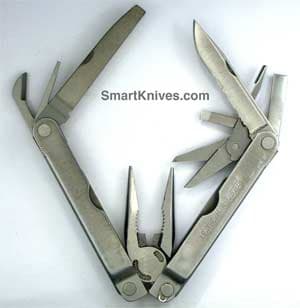
Leatherman's second-generation Pocket Survival Tool, produced 1995–2004. The first Leatherman with a diamond-coated file, spring scissors, and combo blade.
Editorial
The PST II is the Leatherman that taught Leatherman what to build next.
Produced in Portland, Oregon from 1995 to 2004, the PST II carried the original Pocket Survival Tool's 14-tool architecture forward and added three firsts for the brand: a diamond-coated file with a fish-hook groove, spring-action scissors, and a combo blade with a serrated section. None of those are remarkable today — but in 1995, they were the changes that turned the multitool from a backup into a primary EDC.
The build is what a USA-made Leatherman was at the turn of the century. 420HC steel. Stainless frame. No locking tools — every blade folded back under thumb pressure. 102mm closed, 148g on the scale. It is the last multitool from the era before the Wave.
Why It Matters
The PST II is the reason the Wave exists. Leatherman watched users actually carry the PST II, noted what they wanted (locking tools, better ergonomics, outside-accessible blades) and shipped the Wave in 1998 as the answer. The PST II remained in production for six more years as the value option — and as the last Leatherman multitool sold without locking tools. Owning one is owning the design step before the platform that defined the next twenty years.
Best For
- Collectors of pre-locking Leathermans
- Anglers who appreciate the diamond file with hook-honing groove
- Reference piece for understanding the Wave's design lineage
- Anyone who carried one in the 1990s and wants the same tool back
Technical Snapshot
| Attribute | Detail |
|---|---|
| Introduced | 1995 (initial production); branded PST II from approximately 1998 |
| Discontinued | 2004 |
| Closed length | 102 mm / 4 inches |
| Width closed | 28 mm / 1.1 inches |
| Thickness closed | 12.5 mm / 0.5 inches |
| Open length | 6.22 inches / 15.8 cm |
| Weight | 148.7 g / 5.2 oz (SmartKnives); 142 g / 5 oz (Multitool Wiki) — minor source discrepancy noted |
| Steel grade (blade) | 420HC stainless steel (combo blade) |
| Frame material | Stainless steel |
| Country of manufacture | USA |
| Locking mechanism | None — no tools lock |
| Tool list | Needlenose pliers, regular pliers, wire cutters, hard-wire cutters, 420HC combo blade (half serrated), diamond-coated file with fish hook groove, wood/metal file, spring-action scissors, large flathead screwdriver, medium flathead screwdriver, small flathead screwdriver, Phillips screwdriver, can opener, bottle opener, ruler (8 in / 19 cm) |
| Number of tools | Approximately 14–15 depending on how plier jaws are counted — source lists include wire cutters, hard-wire cutters, needlenose pliers, and regular pliers as separate items |
| Key firsts vs original PST | First Leatherman with a diamond-coated file (with fish hook groove) and spring-action scissors; also first Leatherman with a combo (half-serrated) blade |
| Sheath | Black leather sheath with snap-button flap; also available in black nylon and camo pancake sheath |
| Production variants | Multiple versions 1995–2003 with documented changes: L-shaped to tapered screwdrivers (1998), PST II labeling added (~1999), beefy pliers pivot (2001), 'Tool' stamp replacing 'USA' on pivot (2002) |
Collector / Field Notes
Date a PST II by tool revision. L-shaped screwdrivers signal pre-1998; tapered drivers came in around 1998. The beefy pliers pivot arrived in 2001. The "Tool" stamp replaced "USA" on the pivot in 2002. Original leather sheaths were standard; nylon and camo pancake sheaths appear in later production. Used market pricing varies widely — clean examples in original sheath with documentation command premiums. Production ran from 1995 to 2004 per Leatherman archival sources.
FAQ
Is the Leatherman PST II still made?
No. The PST II was discontinued in 2004 after a nine-year production run. It was superseded by the Wave and the value-tier Sidekick/Wingman line.
What's the difference between the PST and the PST II?
The PST II added three firsts for Leatherman: a diamond-coated file with a fish-hook groove, spring-action scissors, and a combo blade with a serrated section. The original PST has a plain straight blade, a non-diamond file, and no scissors.
Does the PST II have locking tools?
No. It is the last Leatherman multitool sold without locking tools. The Wave (introduced 1998) was the brand's first locking-tool multitool.
Is the PST II still useful for fishing?
Yes — the diamond file with fish-hook groove and the spring scissors are both legitimately useful at the water. Modern Leathermans (Wave, Charge) carry the same functions in a more refined package.
Where was the PST II made?
Portland, Oregon, USA. Leatherman has maintained domestic production throughout the company's history.
Sources
Frequently Asked
- Is the Leatherman PST II still made?
- No. The PST II was discontinued in 2004 after a nine-year production run. It was superseded by the Wave and the value-tier Sidekick/Wingman line.
- What's the difference between the PST and the PST II?
- The PST II added three firsts for Leatherman: a diamond-coated file with a fish-hook groove, spring-action scissors, and a combo blade with a serrated section. The original PST has a plain straight blade, a non-diamond file, and no scissors.
- Does the PST II have locking tools?
- No. It is the last Leatherman multitool sold without locking tools. The Wave (introduced 1998) was the brand's first locking-tool multitool.
- Is the PST II still useful for fishing?
- Yes — the diamond file with fish-hook groove and the spring scissors are both legitimately useful at the water. Modern Leathermans (Wave, Charge) carry the same functions in a more refined package.
- Where was the PST II made?
- Portland, Oregon, USA. Leatherman has maintained domestic production throughout the company's history.

